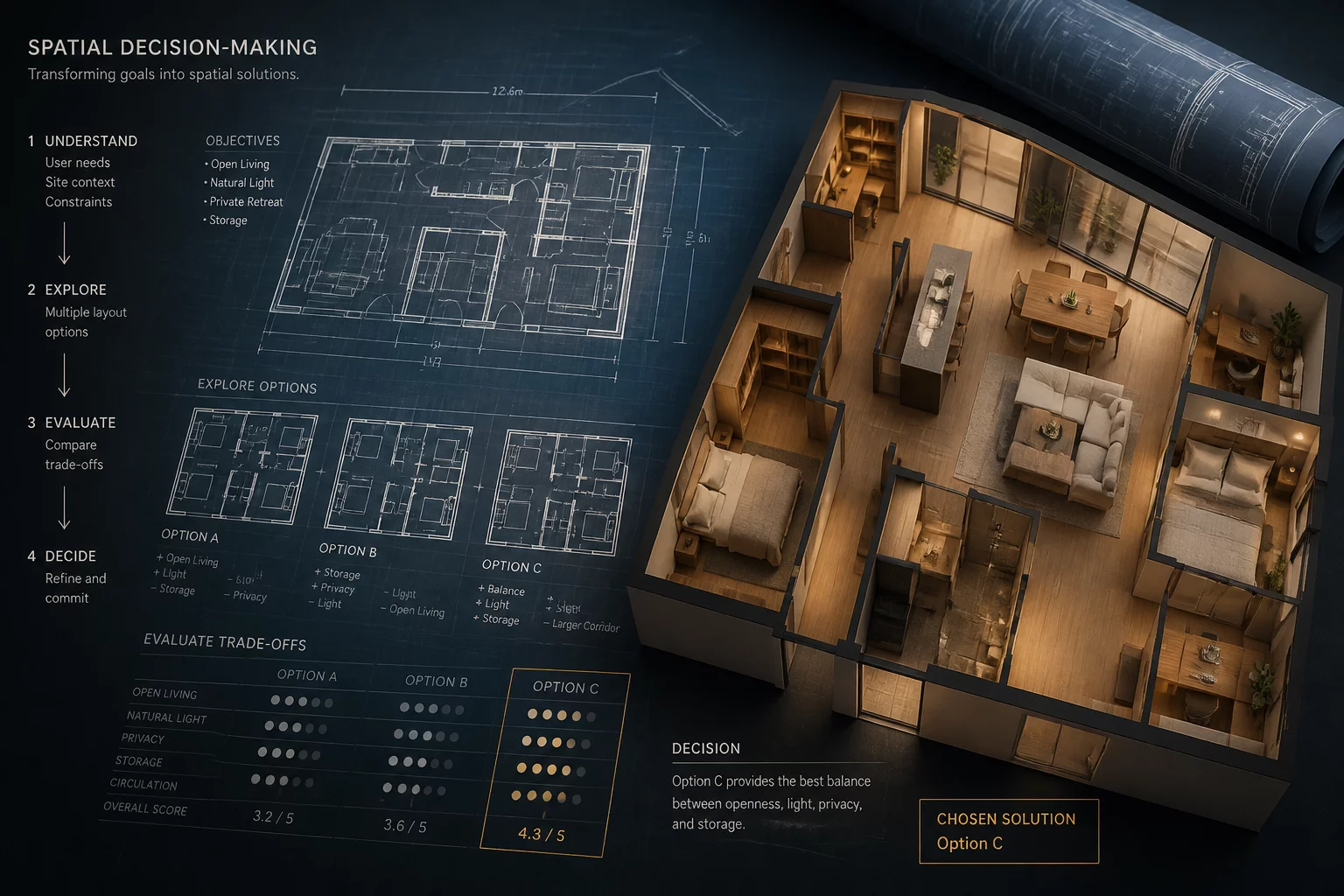
Navigating Architectural Trade-offs
The Decision Index serves as a strategic compass for anyone navigating the treacherous waters of residential spatial planning. Most homeowners approach layout changes through the lens of aesthetic desire or immediate convenience, yet these choices often ignore the underlying structural logic required for a high-functioning environment. Without a mathematical way to weigh priorities, we find ourselves trapped in rooms that look beautiful but fail to facilitate daily life.
This framework introduces a method for categorizing spatial needs into primary, secondary, and tertiary tiers. In a typical renovation, a primary need—such as kitchen circulation—might clash with a secondary desire for a larger dining island. Without an index, the loudest voice in the room often wins. By applying a weighted score to each element, the architect can demonstrate why a certain compromise is objectively superior for the long-term inhabitants.
We evaluate factors such as Visual Weight, Acoustic Separation, and Movement Efficiency. For instance, if a living room scores high on Visual Weight due to heavy furniture but low on Movement Efficiency, the index signals a conflict that needs immediate resolution. It moves the conversation from personal preference to objective utility, ensuring the home evolves attached to the real habits of the family.
Eve
Analyzer • 2026-06-08
Frank
Analyzer • 2026-06-09