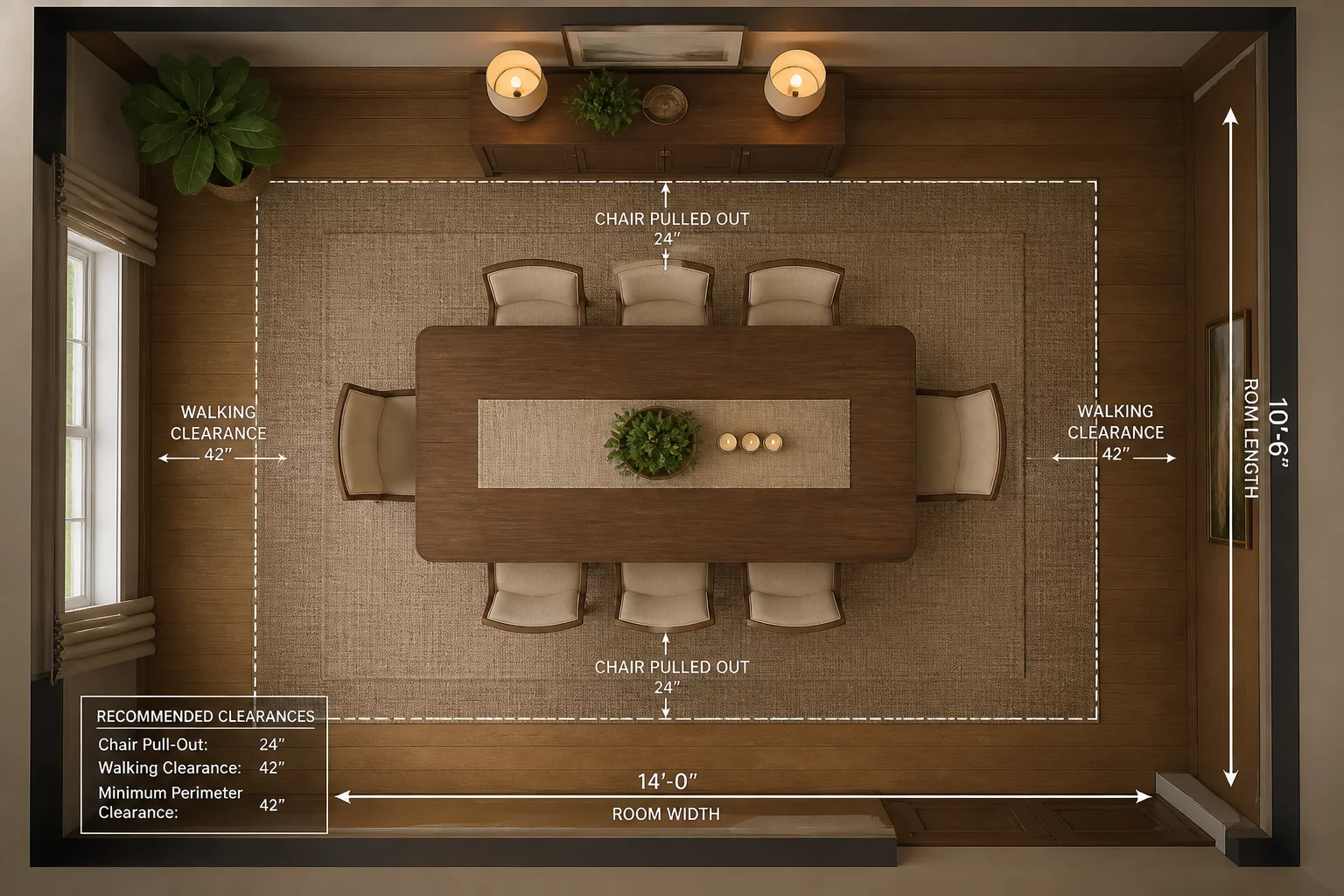
A successful dining area functions as the transition point between the active kitchen and the social living zone. The primary logic behind a well-planned dining space isn't just about fitting the largest possible table into a room, but about preserving the 'movement flow' that occurs when the table is in full use. Many homeowners prioritize seating capacity over circulation, leading to a 'pinched' layout where guests are trapped behind chairs or paths to the kitchen are blocked.
The Ergonomics of Pull-Out Clearance
To ensure a comfortable experience, one must calculate the 'pull-out zone' for each chair. A minimum of 60cm is required just to slide a chair out and sit down. However, for a true movement path to exist behind a seated person, that distance must increase to 90cm or 110cm. Without this allowance, the dining area becomes a physical barrier within the home, disrupting the natural rhythm of household activities.
Scaling the Table to the Architectural Volume
The physical size of the table should correspond to the room's proportions, not just the number of family members. In smaller footprints, a round table often performs better because it lacks sharp corners that interrupt circulation paths. In open-plan layouts, the dining area must be 'anchored'—often by lighting or a rug—to prevent it from feeling like furniture floating in a hallway. The structural logic dictates that the table remains the focal point while maintaining a 360-degree accessibility profile.
Social Psychology and Spatial Density
Beyond physical measurements, there is a psychological layer to dining density. A table that is too large for its space creates a sense of 'clutter stress,' making the act of dining feel cramped and formal rather than relaxed. Conversely, a table that is too small for a large room can feel lost, failing to provide the necessary visual weight to define the zone. Balancing these priorities requires a disciplined approach to furniture selection and a refusal to compromise on essential walking paths.
No analysis has been posted yet. This could be your first comment.